
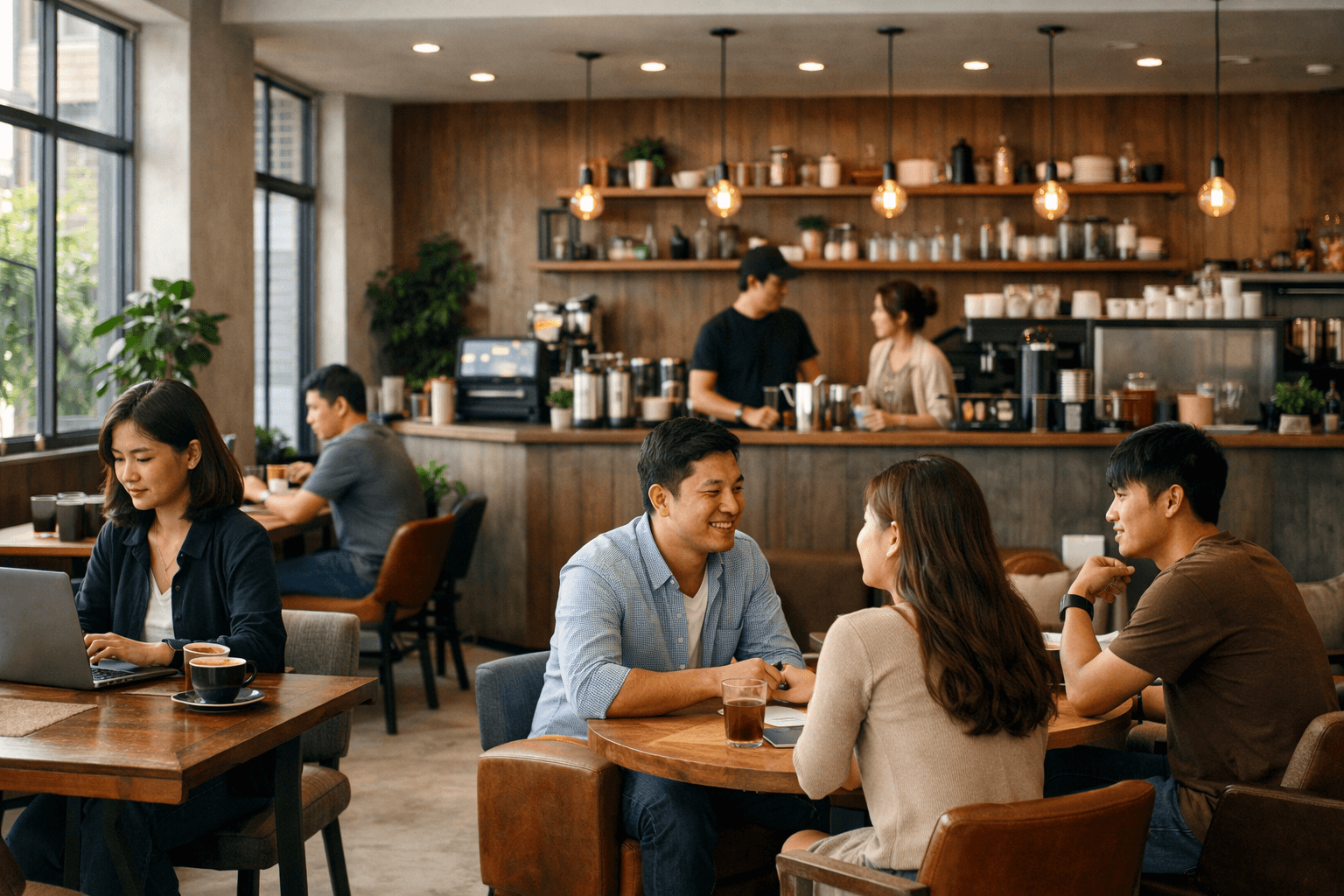
Are customers buying a drink or the right to use a space?
The trend among coffee shops and beverage chains in Vietnam is revealing a problem that seems small but is far from simple: a cup of coffee may be finished within minutes, while the accompanying table is used for hours. This gap forces shop owners to view pricing, premises and seating efficiency as parts of the same calculation.
According to figures cited by Tuổi Trẻ from an iPOS report, in 2025, the proportion of customers spending 35,000 dong or more on a drink rose from 47.7% to 57.5%. The report also classifies outlets with an average drink price of between 30,000 and 70,000 dong per item as mid-market.
These figures do not mean that customers will accept every higher price. What is notable is that the value of each visit is increasingly made up of several layers: the drink, seating, air conditioning, internet access, privacy, opportunities to meet others and a convenient location. Space has become part of the product.
Space must serve a specific need
In major cities, coffee shops are increasingly taking on the role of a “third space”, between home and the workplace. According to Tuổi Trẻ, customers may visit a shop to work, study, meet others or connect, rather than simply drink coffee and leave.
This need creates different ways of organising the premises. A shop serving people who work needs sufficiently large tables, convenient power outlets and a suitable acoustic environment. A space intended for meetings requires different seating arrangements, distances and service rhythms. Some models also combine a coffee shop with a co-working area or provide private rooms.
Therefore, being “beautiful” is not yet a sufficiently clear positioning. A shop intended for a short meeting cannot operate like a place that welcomes customers working for many hours. Lighting, sound, table size, seating distance and the way staff approach customers must all answer the same question: what is this space designed for?
The costs behind a seat occupied for many hours
Comfortable seating can make a difference, but it also brings costs throughout the customer’s stay. Electricity, water, cleaning, furniture maintenance and counter staff do not stop being costs once the order has been delivered.
Tuổi Trẻ reported on a “cocoon coffee” model in Thành phố Hồ Chí Minh where customers sit for between 8 and 10 hours. The shop owner said that investment in tables, chairs and space for this customer segment was considerable; operations were also complex because staff needed to be present almost continuously and cleaning had to be carried out frequently.
This is easy to overlook if a shop only compares the selling price with the ingredient cost of the drink. Prices need to reflect how customers use the space, not just the recipe.

To assess performance accurately, shop owners can compare the bill value with length of stay, occupancy rates by time slot and revenue per seat. A busy area does not necessarily create efficiency if seats are occupied for long periods but the bill value is not enough to cover the cost of service.
Chains are gaining market share, but expansion remains insufficient
The overall industry picture shows that economies of scale are becoming more evident. According to the introduction to the 2024 Vietnam Food and Beverage Business Market Report on Horeca School Asia, the country had 323,010 F&B outlets; more than 30,000 outlets closed in the first six months of the year. The revenue market share of chain models rose from 5.2% in 2023 to 7.3% in 2024.
Scale enables chains to spread management, purchasing and technology costs across multiple outlets. However, adding more shops does not automatically create a better system. If portioning, training, stock control or maintenance is not yet stable, each new outlet can also multiply inconsistencies.
According to Nhân Dân, businesses are shifting their investment focus from simply opening more outlets towards standardising quality and improving operational efficiency. Areas of focus include espresso machines, grinders with portion control, roasting and processing equipment, water filtration systems, automated beverage preparation solutions, sales, inventory and customer management software, and equipment that saves labour, electricity and water.
These developments point to a practical principle: expansion should be the result of the ability to repeat quality and processes, not a substitute for standardisation.
Standardising operations does not mean copying the space
Standardisation does not require every shop to have the same type of furniture or décor. What must be consistent are the core commitments: flavour, volume, service time, hygiene, the ability to supply menu items and how mistakes are handled.
An independent shop can also get started without investing in a complex system. Portioning forms, shift handover procedures, equipment inspection schedules, first-in, first-out principles and position-based work allocation charts are all practical foundations. As order volumes or the number of outlets increases, software and automated equipment begin to demonstrate their value more clearly.
| Pressure at the point of sale | Operational response | Metrics to monitor |
|---|---|---|
| Customers staying for a long time | Divide seating areas according to needs and time slots | Length of stay, revenue per seat |
| Inconsistent quality between shifts | Standardise portioning and handover procedures | Remake rate and feedback by shift |
| Long menu, fragmented inventory | Review shared ingredients and slow-selling items | Waste, days of inventory on hand and out-of-stock rate |
| New staff take a long time to familiarise themselves with the work | Write procedures for each position and task | Training time and errors during the probationary period |
| Multiple sales locations are difficult to control | Connect sales, inventory and customer data | Inventory discrepancies and performance gaps between stores |
Owners building a system can refer to the F&B Business Guide. For product operations, the content in the Beverage Preparation Guide should be turned into specific operating documents for each shift, rather than simply stored as separate recipes.

Four questions to answer before opening more sales locations
Why do customers come to the shop?
If the answer is simply “to drink coffee”, the positioning is still too broad. People working, customers meeting others, takeaway customers and those needing a short break between commitments require different types of space and different service rhythms.
What value is included in the selling price?
A higher price needs to come with value that customers can recognise, such as ingredients, flavour, service speed, location or amenities. Attractive décor cannot compensate in the long term for an inconsistent drink.
Can the current store operate consistently?
Before expanding, the business needs to know whether best-selling items maintain their quality across shifts, whether inventory matches sales and whether new staff can follow the correct procedures after training. If results still depend too heavily on one manager or one key employee, the model is not truly ready to be replicated.
What problem is the technology solving?
Equipment and software are only worth investing in when they are linked to a specific bottleneck. Portion-control machines help reduce discrepancies; inventory management systems help identify waste; sales data supports adjustments to staff schedules and the menu. Buying technology before identifying the problem may simply make the old process more expensive.
The customer-facing experience, the back-end system
Trends in cafés and beverage chains in Vietnam are being shaped by two parallel developments. From the customer perspective, buying a drink is increasingly linked to seating, amenities and the purpose for which the space is used. From the business perspective, competitiveness depends more on the ability to maintain quality and control costs across every shift and every store.
Independent cafés still have opportunities if they understand a specific group of needs and organise their operations around that group. Chains have the advantage of scale, but must prove that the experience can be repeated without allowing costs to spiral out of control. No model wins simply by having more seats or more sales locations.
The race therefore takes place on two stages: at the front, the space customers can see; at the back, portioning, inventory, equipment, staff and data. Baby Boss shares the market’s next developments in the F&B Industry News.
References
- Tuổi Trẻ: Cafés selling seating rather than drinks
- Horeca School Asia: 2024 Vietnamese food service business market report
- Nhân Dân: Vietnam’s F&B market enters a new phase of competition
Partner with Baby Boss
Explore products and Baby Boss services, or call 1900998880.
Shopee · TikTok · Instagram · Threads · YouTube · LinkedIn · Zalo OA · Pinterest
Comments