
Consumers are weighing up value rather than simply chasing the lowest price
F&B spending behaviour in 2025 shows a notable divergence: customers are still setting aside a budget for eating and drinking out, but are being more cautious with each choice. According to information reported by the Electronic Government Newspaper, consumers tend to prioritise good-quality products at affordable prices, rather than automatically choosing the cheapest option.
This does not indicate that all customers are moving towards the same price point. Lunch, everyday drinks, a weekend outing or a dessert after a meal may each involve different spending thresholds. The common thread is that customers want to see a reasonable link between the price paid and the value received.
The mid-range drinks segment stands out in the first half of 2025
The report produced by iPOS.vn in collaboration with Nestlé Professional, based on a survey of more than 830 F&B business owners or managers and more than 1,286 consumers nationwide, recorded changes in drink choices. Some 77,5% of consumers prioritised products priced between 21.000–50.000 dong, highlighting the appeal of the mid-range segment after a period of experimenting with lower-priced options.
For lunch, the proportion spending under 30.000 dong per meal rose from 8,8% to 16,5%, while the 31.000–50.000 dong range accounted for 55,7% of regular spending. These figures were stated in information published by iPOS.vn. They reflect caution around each purchase occasion, but do not mean that customers will only accept low-priced products.
For F&B brands, the mid-range segment should therefore be viewed as a distinct area of competition. Customers may save on an everyday occasion, but remain willing to pay more when a product creates a clear perception of quality, portion size, flavour or convenience.

What signals are there for ice cream brands?
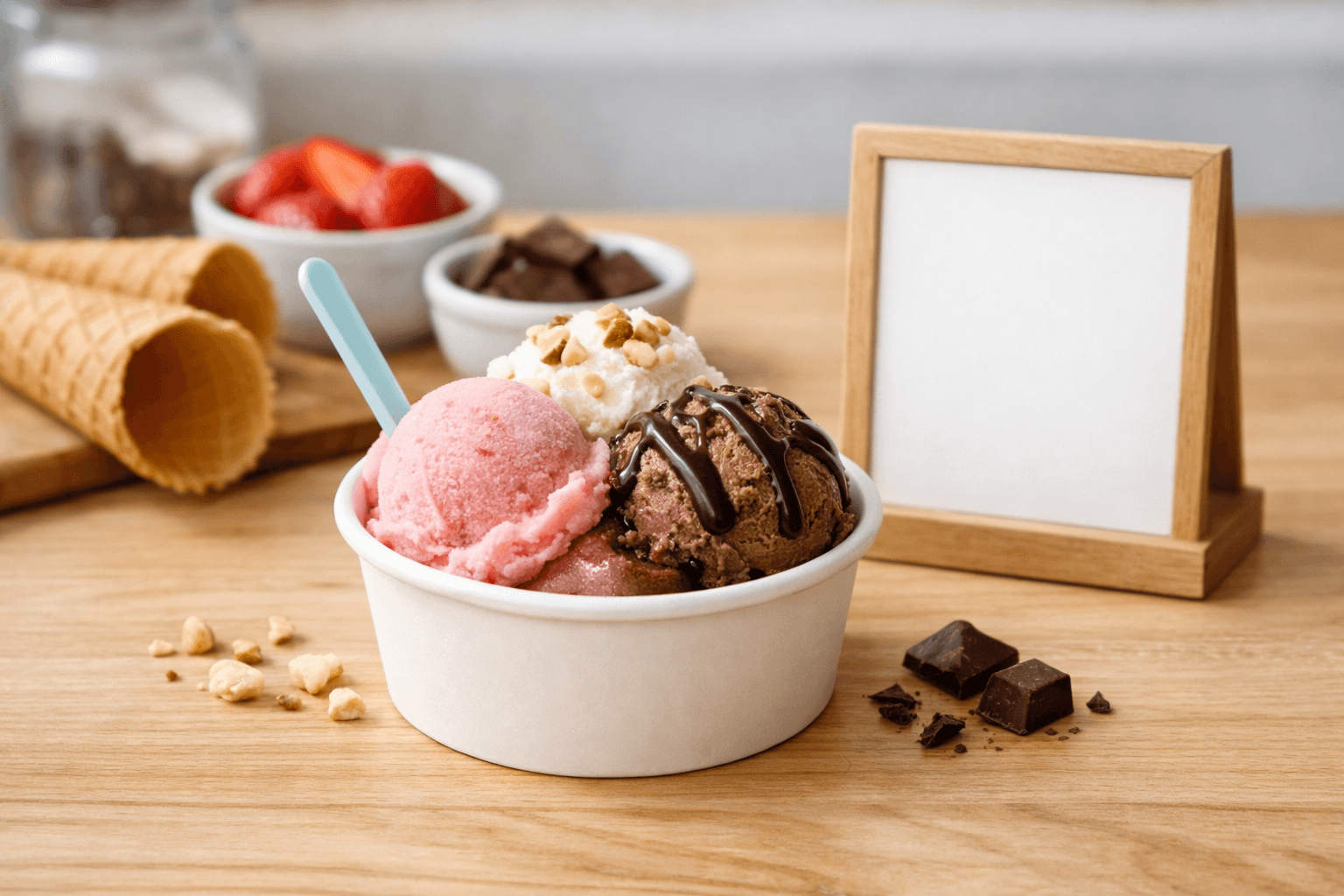
Ice cream often appears in a range of situations: as a quick snack, a dessert after a meal, a choice for the family or a product associated with a get-together. Each situation has a different willingness to pay and different evaluation criteria. Therefore, associating a brand with just one price point may overlook customers’ varied needs.
For ice cream brands, data on F&B spending behaviour in 2025 suggests three questions to consider when developing a product range:
- Are customers buying the product for quick consumption, sharing or to create a memorable experience?
- Does the current price clearly explain the quality, portion size and points of difference?
- Does the product offer suitable options for both everyday needs and weekend occasions?
These are guiding questions, not a conclusion that every ice cream range should be positioned in the mid-range segment. The answer should be based on the product, sales channel, business location and specific customer group.
Product positioning should start with the purchasing occasion and the value received
Rather than simply promoting an attractive price, a brand can clearly explain what customers receive with each option. A compact portion of ice cream may suit the need for quick consumption; a higher-end product range needs to show points of difference that are easy to recognise through its flavour, appearance or serving style.
Baby Boss’s range can be considered in several ways, from Gelato Baby Boss products to Gelato Stick and 3D fruit ice cream. These options do not automatically guarantee business success; they simply provide a basis for shop owners to discuss further how to match products with purchasing occasions and customer segments.

For shops building their business model, reviewing the range should go hand in hand with operational considerations and the in-store experience. The F&B business guide can be a starting point for organising questions about products, customers and selling methods, rather than adjusting prices based on instinct.
Three approaches to avoid when pursuing “affordable prices”
- Cutting prices without clarifying the value: a low price may attract trial purchases, but it is not enough on its own to create a reason to return.
- Using one price point for every purchasing occasion: customers buying quickly and those seeking an experience may not need the same product.
- Expanding the range without a clear purpose: adding more flavours or formats without addressing a specific need will make the choice more confusing.
What businesses should continue to monitor
Signals from the first half of 2025 show that the market is not moving in a straight line from “premium” to “cheap”. Customers are allocating their budgets more flexibly: saving on some occasions while still spending on options they consider worthwhile.
For ice cream brands, it is important to track both price points and reasons for purchase. Sales data by time slot, product group and whether the product is consumed on the premises or taken away will help businesses verify which forms of value customers genuinely care about.
Editorial note: The figures in this article are taken from the cited published sources. They are not sales forecasts or a guarantee of results for any particular brand, shop or product.
Partner with Baby Boss
Explore products and Baby Boss services, or call 1900998880.
Shopee · TikTok · Instagram · Threads · YouTube · LinkedIn · Zalo OA · Pinterest
Comments