
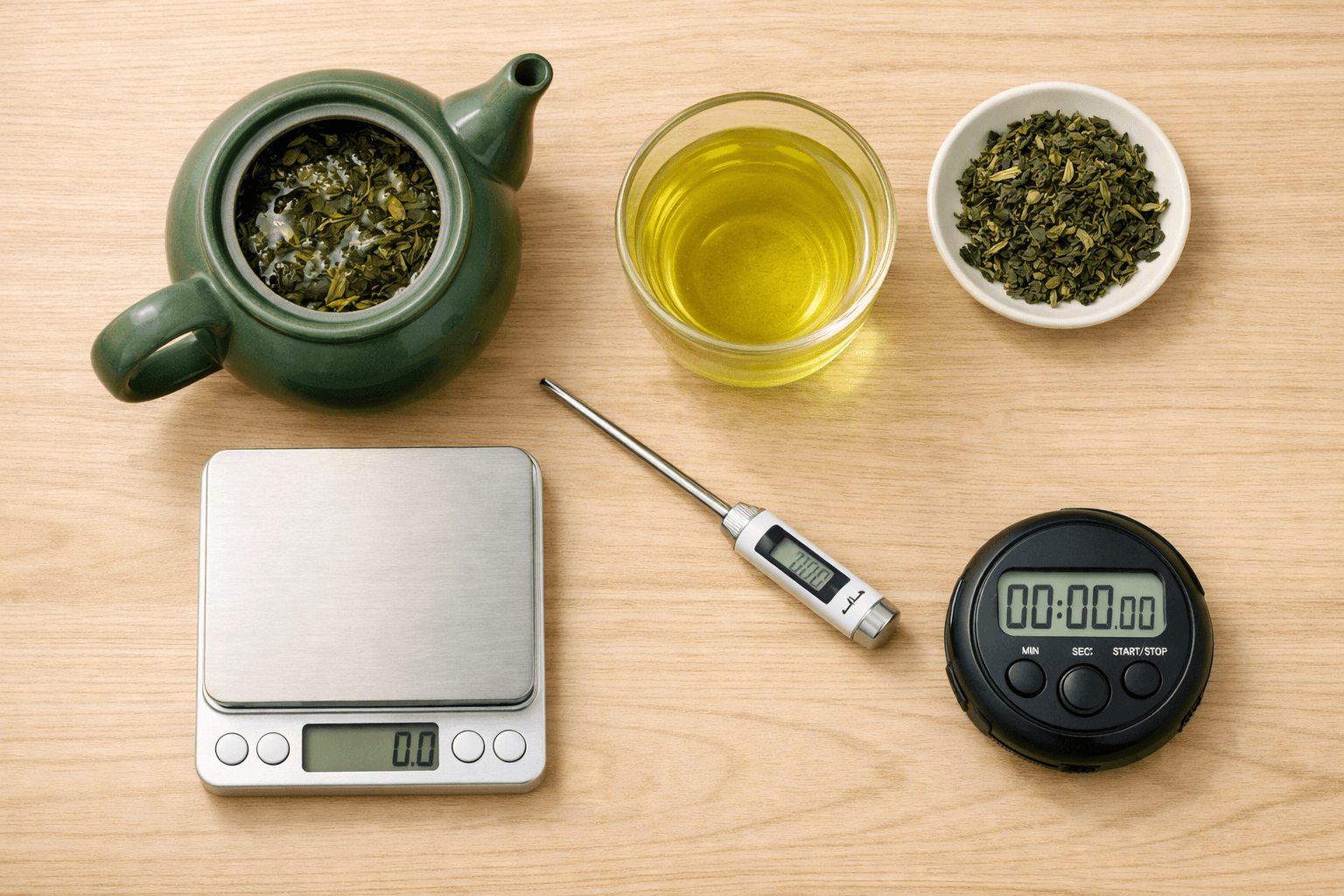
The first batch is fragrant and fresh, while the next tastes dry and sharply bitter, despite using the same tea bag. When this happens repeatedly, the cause may not lie in the ingredients. Green tea brewing technique and astringency control depend first and foremost on three measurable variables: the tea-to-water ratio, water temperature and steeping time.
These three parameters are closely linked. Hotter water promotes faster extraction; using more tea makes the brew more concentrated; while steeping for longer extends the time the leaves remain in contact with the water. Once the time is up, extraction continues if the leaves have not been strained. Therefore, a recipe is only truly complete when it specifies both when and how to strain.
Why does the same tea taste different from one batch to the next?
Green tea is sensitive to brewing conditions. According to the commercial green tea brewing guide from Xin Guan Tea, excessively high temperatures or overly long steeping times can cause bitter and astringent compounds to be over-extracted, overpowering the tea’s freshness and natural aroma.
This is also why you should not change the temperature, amount of tea and steeping time simultaneously when testing a recipe. If the next batch is easier to drink, the brewer will not know which change produced the result. A clearer approach is to keep two variables constant, adjust only one variable in each trial, and record the differences.
In addition to the three main parameters, the water source also needs to remain consistent. Xin Guan Tea notes that soft water, hard water and filtered water can create differences in aroma, mouthfeel and the overall character of the tea. A recipe used at the counter should therefore be tested with the exact water source that will be used every day.
Water temperature determines the extraction rate
Pouring freshly boiled water directly over the tea is a common mistake. For commercial green tea brewing, Xin Guan Tea suggests testing at 80–85°C: boil the water, allow it to cool slightly, measure the temperature again, and only then add the tea.
Meanwhile, the Tea Tower guide specifies a range of 70–80°C for some loose-leaf green teas, specifically around 70°C for Gyokuro and around 75–80°C for Sencha and Longjing. The same source does not recommend using boiling water at 100°C for the teas mentioned.
The two temperature ranges are not contradictory when viewed in their proper context: they are reference points for different teas and brewing scales, not a single universal recipe. When receiving a new ingredient, the counter can select a suitable temperature as a baseline, test a sample, and then make small, step-by-step adjustments according to the desired flavour.

When tea is sharply bitter, how should the temperature be adjusted?
- Keep the amount of tea and steeping time unchanged in the first trial.
- Lower the temperature in small steps rather than changing several parameters at once.
- Use a thermometer; do not estimate the temperature from steam or waiting time.
- Record the temperature at the moment the tea comes into contact with the water, not only the temperature when the water leaves the heating appliance.
The measuring method must also be consistent across shifts. If one person measures in the kettle while another measures after pouring into the brewing vessel, two identical figures on the form may not represent the same actual conditions. You can also refer to the counter-operation methods in the F&B Business Guide.
The tea-to-water ratio must be weighed, not estimated
More tea does not mean the brew will become more aromatic in the same proportion. Too much tea can make the flavour intense and bitter; too little can make the tea thin. For a small test batch, Tea Tower gives a starting point of 2–3 g of tea for 150 ml of water. This is an adjustment point for some loose-leaf green teas, not a fixed ratio for every ingredient or service model.
Reliable electronic scales are more accurate than measuring spoons. Large-leaf tea, rolled tea and broken tea may occupy a similar volume but have different weights. When moving from a tasting glass to a larger batch, first keep the ratio of tea weight to water volume unchanged, and then reassess the flavour.
Form for the initial test batch
| Parameter | Reference point | Recording method |
|---|---|---|
| Amount of tea | 2–3 g | Weigh using electronic scales |
| Amount of water | 150 ml | Measure according to the actual volume used |
| Water source | Daily-use source | Keep unchanged between trials |
| Adjustment | One variable per trial | Record intensity, bitterness, astringency and aroma |
The 2–3 g per 150 ml starting point is suitable for sample testing based on the reference source above. If the final product also contains ice, milk, sugar or other ingredients, the tea base still needs to be assessed separately before being added to the complete beverage recipe.
Steeping time ends only once the leaves have been strained
Tea Tower gives a reference range of 1–2 minutes for the Gyokuro, Sencha and Longjing teas mentioned in the guide. The appropriate time in actual operation must still be determined together with the selected tea, temperature and ratio.
If the tea remains bitter after the temperature has been controlled, this source suggests shortening the steeping time in 30-secondsteps. The important point is to change only the time in that trial. If you also lower the temperature or reduce the amount of tea, the results will be difficult to compare.
Starting a timer is not enough. When the alarm sounds but the leaves are still in the vessel, the tea continues to extract. With a large batch, waiting until the time is up before looking for a strainer or container also creates a delay: the filtered liquid at the end has been in contact with the leaves for longer than the liquid at the beginning.

Controlling time at the counter
- Prepare the strainer and receiving jug before starting the brew.
- Start the timer at the same point in every trial, such as when the leaves have been evenly wetted.
- Filter the entire batch as soon as it reaches the target time.
- Do not leave some of the water continuing to steep the leaves while the rest has already been poured out.
- Record the actual time if filtering is delayed, so that the tea batch can be assessed accurately.
Green tea brewing and filtering process at the counter
Green tea brewing technique and astringency control do not depend on three isolated figures. The way the leaves are wetted, when the timer is started and how the tea is filtered must also be repeated consistently. The framework below applies to trials using dry green tea for beverage preparation, based on Xin Guan Tea’s commercial process.
- Weighing the tea and measuring the water: use the same scales, measuring tools and water source for the trials being compared.
- Measuring the temperature: heat the water, let it cool to the selected point and check it with a thermometer before adding the tea.
- Wetting the leaves: add the tea to the hot water, stir gently so that the leaves are evenly submerged and start timing at the specified point.
- Keeping the procedure consistent: Xin Guan Tea recommends covering the jug after the leaves are submerged. If this procedure is chosen, every trial and operating shift should follow it in the same way.
- Filtering as soon as the time is up: use a fine-mesh strainer to limit tea particles remaining in the tea liquor.
- Allowing the water to drain naturally: do not press or squeeze the leaves in the strainer. Xin Guan Tea’s guidance recommends this to limit further extraction of bitter, astringent flavours.
The process above is intended for commercial dry green tea. Fresh green tea leaves have different characteristics and require different handling, so individual steps from the two processes should not be combined into an untested recipe.
An easy-to-follow method for testing samples and creating an SOP
A trial is valuable when the brewer knows exactly what has just changed. Choose a base recipe, keep the equipment and water source fixed, then test each variable in a consistent order.
| Trial | Keep constant | Adjust | Points to observe |
|---|---|---|---|
| A | Ratio and time | Temperature | Aroma, freshness and bitterness |
| B | Ratio and temperature | Time | Astringency and aftertaste |
| C | Temperature and time | Ratio | Intensity and balance |
A highly complex evaluation sheet is not necessary. Four brief notes on aroma, intensity, bitterness and astringent sensation have made samples easier to compare. Samples should be coded before tasting so that tasters can focus on the tea liquor rather than being influenced by the parameters.
Once the recipe has been selected, the SOP should clearly state the type of tea, tea weight, water volume and source, target temperature, when to start the timer, steeping time, stirring method, whether the jug should be covered and the filtering method. The document should be placed where staff can refer to it while working, rather than simply being stored as a recipe for reference. Related information can be found in the Brewing Guide.
Common mistakes that make green tea bitter and astringent
- Using water that is too hot: bitterness and astringency can easily overpower the tea’s freshness and aroma.
- Measuring tea by eye: the amount of tea varies according to leaf size and scooping method.
- Not checking the water source: even with the same recipe, the aroma and mouthfeel can still differ.
- Starting the timer at different points: one shift counts from when the water is poured, while another counts after stirring is complete.
- Filtering slowly: the leaves continue to remain in contact with the water after the target time.
- Pressing the leaves in the strainer: this can draw more bitter and astringent flavours into the tea liquor.
- Changing several variables at once: it becomes impossible to identify what made the sample better or worse.
There is no single temperature or time that is right for every type of green tea. Effective green tea brewing and astringency control depend on choosing suitable trial points, measuring accurately and repeating the same sequence of steps from weighing the tea until all the tea liquor has been filtered.
References
- Xin Guan Tea: a guide to brewing green tea for commercial operations
- Tea Tower: a guide to brewing temperatures, ratios and times for several types of green tea
Partner with Baby Boss
Explore Baby Boss products and services, or call 1900998880.
Shopee · TikTok · Instagram · Threads · YouTube · LinkedIn · Zalo OA · Pinterest
Comments