
Last updated: March 2025.
For a refreshing fruit tea, start with the tea base
Fruit tea is not just tea mixed with a few slices of fruit. The tea base provides the flavour structure, while fruit adds aroma, acidity and a refreshing sensation. If the tea is too strong, the fruit flavours can easily be overpowered; if it is too light, the drink may lack depth.
According to the technical brewing guide, green tea or oolong tea is commonly used to preserve a light, refreshing character in fruit tea. Black tea can still be used when a more pronounced and fuller tea flavour is desired, but it should not be brewed too strongly.
A simple principle to remember: the more aromatic and acidic the fruit, the lighter and cleaner the tea base should be, so it does not feel heavy on the palate.
How to choose a tea base according to the desired flavour
| Tea base | Main character | Suitable pairings |
|---|---|---|
| Green tea | Light, refreshing, fresh | Orange, mandarin, grapefruit, apple or kiwi |
| Oolong tea | Balanced between light and full-bodied | Peach, raspberry or fruits with a pronounced aroma |
| Black tea | Full-bodied, more intensely aromatic | Pairings that need a prominent tea base, but the tea concentrate should not be too strong |
The list above is a flavour-pairing guide based on the materials provided, not a fixed recipe. The final strength also depends on the type of tea and the brewing method.
If using green tea, the reference source states 80–85°C for 7–10 minutes to limit bitterness. For black tea, the stated range is 90–95°C for 10–15 minutes. You can also refer to the brewing guide for comparison when testing a new batch.
How can you pair fruit to create a balanced fruit tea?
Choose one main flavour and one accent flavour
Do not add too many types of fruit to the same drink from the outset. A more manageable approach is to choose one group to provide aroma or sweetness, then add an acidic ingredient to brighten the overall flavour.

- Watermelon has a mild sweetness and high water content, making it suitable for softening the strong flavour of other fruits.
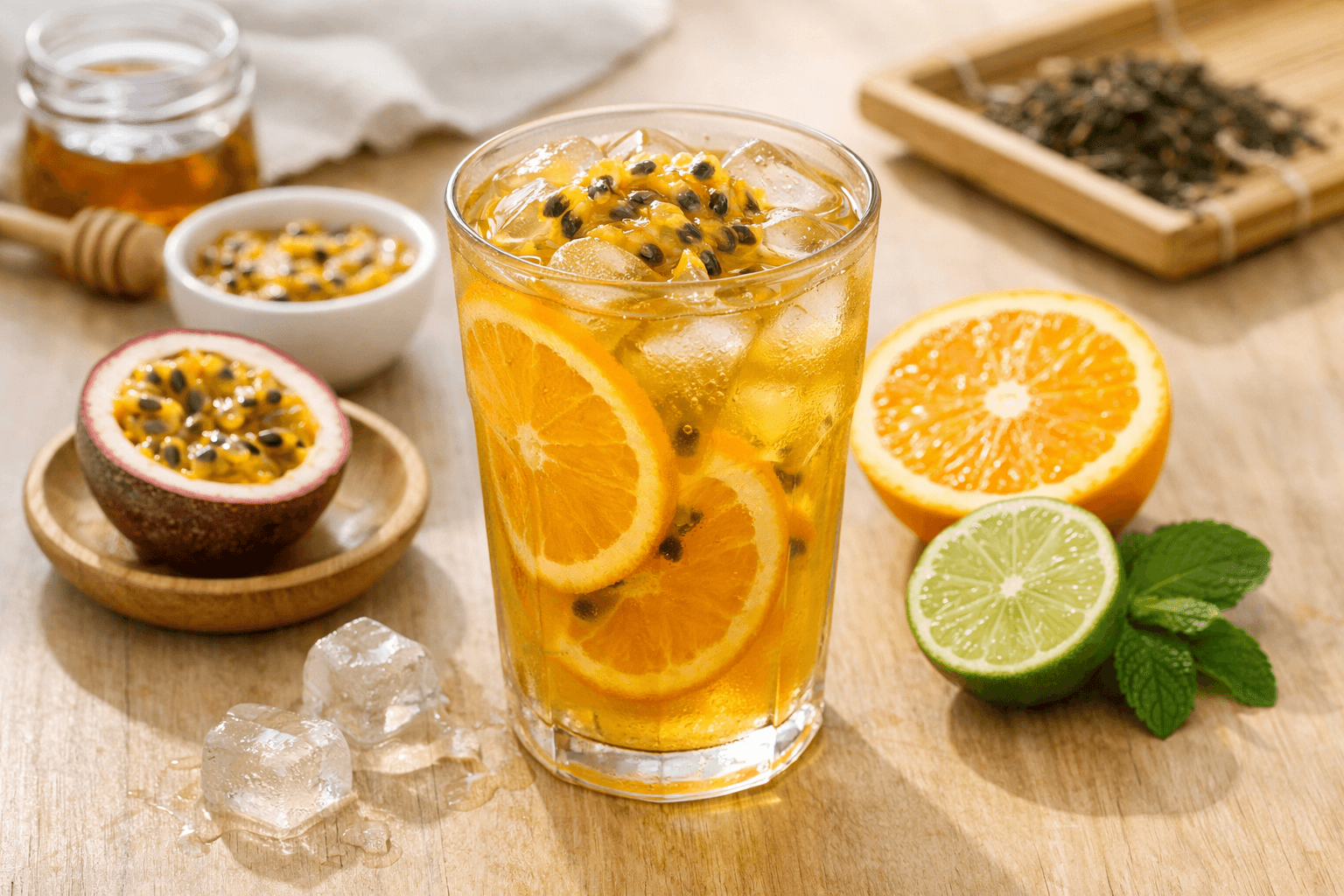
- Orange adds gentle sweetness combined with refreshing acidity and a clear aroma.
- Passion fruit has a distinctive acidity and aroma, helping to reduce an overly sweet sensation.
An easy-drinking cup usually has tea as its foundation, fruit aroma and a touch of acidity to create a lively finish. This is a reference guide; tasting and adjusting for each batch is still necessary.
Use acidity to cut through sweetness without overpowering the tea base
The tropical fruit tea reference material describes passion fruit as having refreshing acidity and a prominent aroma, which can help balance the perception of sweetness. Passion fruit should therefore be viewed as an accent ingredient, rather than necessarily taking over the entire flavour of the drink.
With orange or fruits with a lighter flavour, you can retain some fruit slices to enhance the aroma while drinking. The specific pairing should be based on the fruit's ripeness, natural sweetness and the strength of the tea concentrate. The sources provided do not specify standard quantities for each type of fruit.
Steps for making clear fruit tea
- Choose the tea base: start with green tea or oolong tea if a refreshing flavour is the priority. Use black tea only when a more pronounced tea character is desired.
- Brew and cool the tea concentrate: control the temperature and brewing time according to the type of tea. Do not make the tea too strong, as it may mask the fruit aroma.
- Prepare the fruit: cut or juice it according to the type of fruit, keeping the flesh and juice to a moderate level. With orange, strawberries or passion fruit, gently muddle only enough to release the essential oils and juice.
- Pair the flavours: combine the tea concentrate with the aromatic fruit group, then add an acidic or sweet ingredient to adjust the flavour. Tasting at each step makes it easier to identify which ingredient is overpowering the others.
- Finish: add ice to chill the drink and use attractively cut fruit if you want to enhance the refreshing sensation. The specific amount of ice and ingredient quantities have not been determined by the sources provided.
Muddling too vigorously is a common mistake because it breaks down the fruit flesh, making the drink cloudy and less visually appealing. The technical brewing guide also recommends using a gentle touch when handling fresh fruit.
Why does fruit tea taste astringent or lose its aroma?
Brewing the tea too strongly
Astringency is usually more pronounced when the tea concentrate is too strong for the amount of fruit aroma. Start with a moderately strong tea base, then taste again after adding the fruit instead of trying to make the tea concentrate very strong from the outset.
Muddling the fruit too vigorously
Muddling vigorously does not necessarily extract more aroma. According to the accepted source, this can make the drink cloudy and affect the appearance of the tea.
Combining too many aromas at once
Orange, passion fruit, watermelon and many tropical fruits each have their own character. When too many ingredients are used without defining a main flavour, the drink can easily become muddled. Try one tea base, one main fruit and one acidic accent first.

Quantities and storage: what to check before selling
The sources provided do not give a complete measured recipe for one glass of fruit tea, including the quantities of tea, water, fruit, sweetener and ice. Therefore, this guidance should not be regarded as a fixed commercial recipe. The person preparing it should test small batches, record each parameter and adjust according to the actual ingredients.
The reference source states that brewed tea should only be used within 4–6 hours, but this information appears in a specific preparation guide and is not yet a recommendation applicable to all types of tea, ingredients or operating conditions.
WHO notes that fresh fruit and vegetables have been associated with microbiological safety incidents at various stages, from production to the point of sale. Therefore, establishments need to develop sanitation, temperature-control and storage-time procedures appropriate to food-safety requirements.
Editorial note: if standardising the process for sale at a shop, it is advisable to separate the test recipe, preparation process and storage requirements. These elements should be tested using actual ingredients, equipment and serving conditions.
Turning guidance into a consistent preparation process
Once you have found a combination that suits your taste, record the type of tea, brewing method, main fruit, souring ingredient and mixing order. Keeping records helps identify the reason when today’s tea tastes more astringent, sweeter or less fragrant than the previous batch.
If you are developing a drinks menu for a shop, you can refer to F&B business guidance to connect taste testing with operational procedures. Baby Boss is a brand with Gelato products and content supporting food and beverage business models; you can contact Baby Boss when you need to discuss product direction and business models further.
Partner with Baby Boss
Explore products and Baby Boss services, or call 1900998880.
Shopee · TikTok · Instagram · Threads · YouTube · LinkedIn · Zalo OA · Pinterest
Comments