
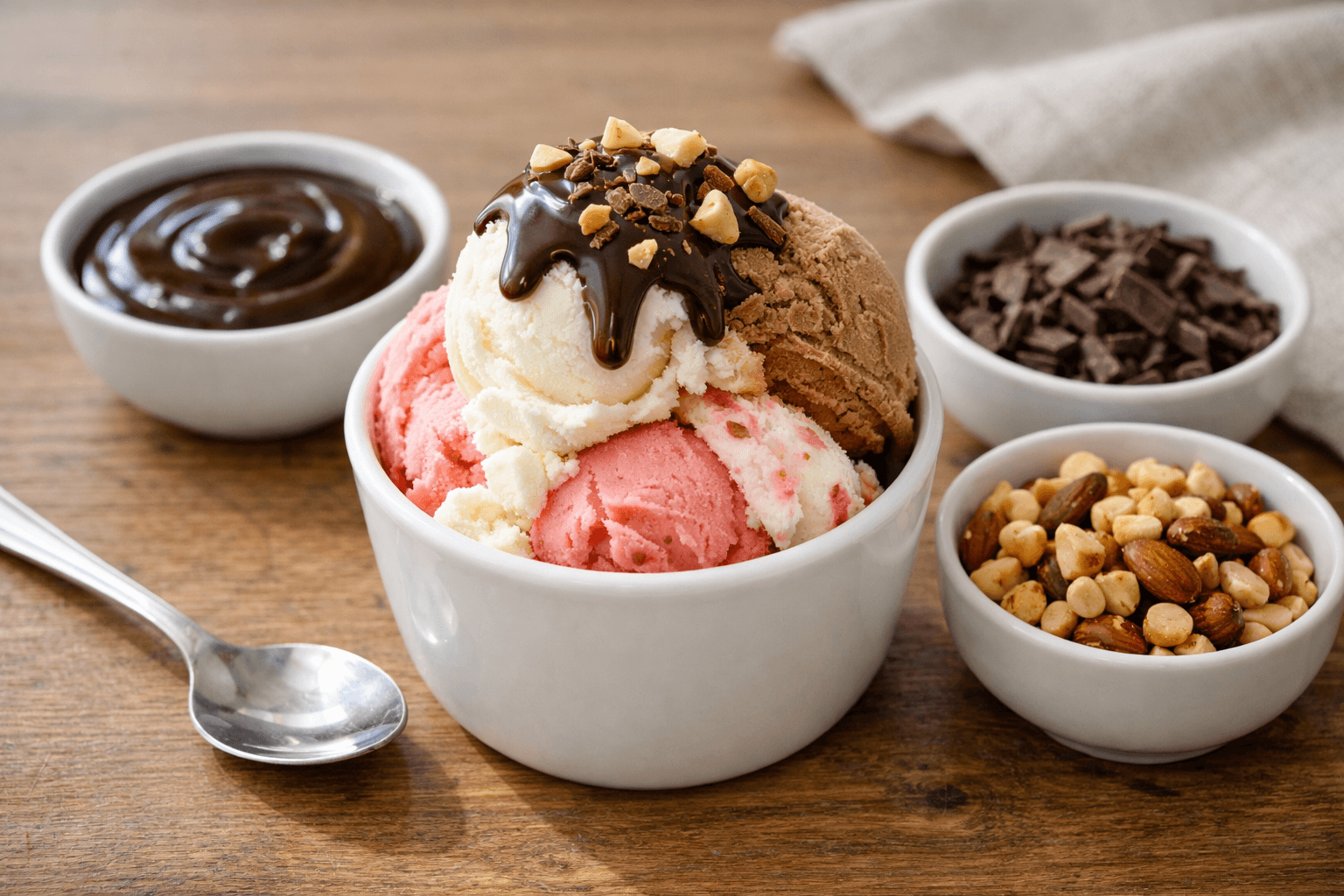
Gelato toppings are not just for decoration
The right topping can add crunch, richness or a contrasting sensation to smooth, soft gelato. However, Gelato toppings should not be chosen simply because they look appealing. The sweetness, fat content, moisture and size of the ingredients all affect the eating experience.
At gelato counters in Vietnam, Nutella, chocolate, pistachio and roasted nuts are often mentioned as flavour pairing options. These are suggestions based on user experiences and community discussions, not professional formulas applicable to every batch of gelato.
If the topping is mixed directly into the gelato base rather than sprinkled on the surface, balancing the ingredients requires even more attention. Gelato training materials suggest that makers need to understand the ingredients and how they affect the freezing process, rather than adding ingredients by instinct. You can refer to gelato formulation materials.
The information below is suitable for gelato makers, counter staff and people testing a menu. For food additives, it is advisable to check the current database, as Codex GSFA is updated when new regulations are adopted.
How to choose toppings according to the gelato flavour
First, determine whether the topping should highlight the gelato flavour or create contrast. With a light gelato base, a bold topping can become the focal point. With a base that already has several layers of flavour, a simple topping is usually easier to keep balanced.
| Characteristics of the gelato base | Topping selection | What to check |
|---|---|---|
| Milky or light creamy flavour | Chocolate, chocolate sauce or roasted nuts | Is the topping too sweet, too rich or overpowering the base flavour? |
| Chocolate flavour | Roasted nuts or a rich, nutty topping | Bitterness, crunch and the amount of crumbs when eating |
| Pistachio or other nut flavours | Moderately sized nuts or a thin chocolate coating | Are the nut flavours repetitive and becoming too heavy? |
| Fruit flavours | A crunchy topping or one with moderate sweetness | Moisture and the risk of creating a soft, soggy sensation when it comes into contact with the gelato |
The table above is a flavour-testing framework, not a fixed formula. The same type of topping can create different sensations depending on the gelato base, serving temperature, piece size and time of addition.
Prioritise the right amount of contrast
Soft, strongly flavoured gelato often works well with an element that has a different texture, such as roasted nuts or chocolate crumbs. If both the gelato base and the topping are too sweet and too rich, the overall result may become heavy after a few spoonfuls.
Do not assess a topping only when eating it on its own. Try it with a spoonful of the gelato base, as the aim is harmony between the two components, not finding the best-tasting ingredient when eaten alone.
Topping categories that often attract interest
Chocolate and chocolate sauce
Chocolate creates a rich flavour and a distinctive colour, while chocolate sauce provides a soft, glossy sensation and is easy to drizzle over the surface. A gelato serving recipe from Food Network instructs users to place the different toppings in separate bowls, drizzle chocolate sauce over the gelato and let customers choose how much topping they want.
This serving method can be referenced in the Food Network gelato bar recipe. However, the source recipe is intended for a specific serving method, not as a general quantity guide for every type of gelato.

With sauces, observe the consistency and the amount drizzled over each portion. The same ratio should not be applied automatically to every gelato base or serving model.
Nutella and spreadable creams
In community discussions, Nutella is often mentioned when users want to increase the rich, nutty-chocolate sensation of gelato. This is an experiential perspective, not a basis for claiming that this topping always makes gelato smoother or suits every gelato base.
If using a spread in the recipe rather than as a topping, read the ingredient information and assess the amount of sugar, fat and added solids. The cited gelato formulation materials note that chocolate, biscuits or Nutella can contribute to several different ingredient groups. Therefore, adding them may affect the balance and freezing process.
Pistachio and roasted nuts
Pistachio, pecans and roasted pine nuts are often chosen when diners want a nutty flavour and crunchy texture. Pairing roasted nuts with chocolate gelato is also a flavour combination worth trying, but it should be assessed directly on the gelato base intended for serving.
With roasted-nut toppings, pay attention to the piece size, crunch and roasted aroma. Nuts that are too large can make scooping the gelato less convenient; nuts that have absorbed moisture can easily lose their textural advantage.
Why can toppings affect the structure of gelato?
Added ingredients bring more than just flavour. They may contain sugar, fat, milk, solids or water in varying amounts. When mixed into the gelato base, these components can affect the balance and freezing process.
Gelato training materials emphasise that makers need to know how raw ingredients affect the product and understand how the ingredients interact during freezing. The materials also describe formulation as a process of balancing multiple ingredient groups and testing in the kitchen. Therefore, not every topping should be treated as an ingredient that can be “added without consequences”.
For food additives, the Codex GSFA sets out the conditions of use for permitted additives in each food category. This database can be searched by additive name or code, function and food category, and is updated when the Codex Alimentarius Commission adopts new regulations. It can be cross-checked at the Codex GSFA database for food additives.
This does not mean that every topping or additive is automatically suitable. Check the label, intended use and relevant legal requirements at the place of business.
A controllable way to test toppings
- Choose a base gelato flavour: clearly note the flavour, perceived sweetness and the desired outcome, such as adding crunch or intensifying the chocolate flavour.
- Try it in serving form first: sprinkle or drizzle a small amount over a scooped portion of gelato, rather than immediately mixing it into the entire batch.
- Assess each criterion: record the aroma, flavour, crunch, sweetness, richness and the extent to which it masks the base gelato flavour.
- Check the ingredients: if adding a topping to the recipe, read the nutritional information and ingredients on the label so that you do not overlook added sugar, fat or solids.
- Change only one factor at a time: testing each topping separately makes it easier to identify the cause when the result is not suitable.
Keeping toppings separate is also suitable when customers at the counter have different preferences. This approach allows customers to choose the amount they use and helps staff assess each topping without mixing it in advance into the entire batch of gelato.

Common mistakes when pairing toppings
Choosing by appearance while overlooking the base flavour
Toppings with multiple colours or layers do not necessarily make a gelato portion taste better. If the topping is too strong, the diner may taste only the topping and no longer recognise the distinctive character of the gelato.
Mixing too many ingredients at once
When chocolate, spreads, nuts and sauces appear together, it is very difficult to identify which ingredient creates the unsuitable flavour or texture. Testing each group separately makes the adjustment process clearer.
Treating the topping as purely decorative
This is a mistake to avoid when the topping is added directly to the gelato base. An ingredient may add sugar, fat or solids, so it needs to be taken into account when developing the recipe rather than being balanced by eye alone.
Claiming a shelf life without supporting data
The sources used in this article do not provide a general shelf life for gelato after each type of topping has been added. Therefore, follow internal procedures, the ingredient manufacturer's instructions and appropriate food safety requirements; do not assume a fixed timeframe.
Suggestions for applying this at a gelato counter
If you want customers to create their own combinations, you can divide toppings into easy-to-understand groups: sauces, chocolate pieces and roasted nuts. Keeping each group separate allows customers to control the amount they use, while also helping staff observe which ingredients are chosen more often without mixing them in advance into the entire batch of gelato.
For counters serving local customers or operating models that often change the menu seasonally, clearly state the topping name, ingredients that may cause confusion and suggested ways to use it. This presentation helps staff give more consistent advice while still allowing customers to adjust the flavour to their preference.
If you are developing or adjusting a menu, you can also see Gelato Knowledge and refer to Gelato Pro by Baby Boss to discuss suitable ways of using it. Toppings should support the gelato flavour and serving process, not make recipe control less clear.
Conclusion
Effective Gelato toppings usually begin with balance. A topping can add crunch, a nutty flavour or a chocolate accent, but it should not overpower the base gelato. When a topping is added to the recipe, treat it as part of the complete ingredient system and test it with proper records.
Choose one base flavour, test one topping and clearly assess each criterion is a simple way to find a suitable combination without rushing to conclusions that go beyond the available data. For product development or counter setup, you can contact Baby Boss to discuss it further.
Partner with Baby Boss
Explore products and Baby Boss services, or call 1900998880.
Shopee · TikTok · Instagram · Threads · YouTube · LinkedIn · Zalo OA · Pinterest
Comments