
Updated March 2026.
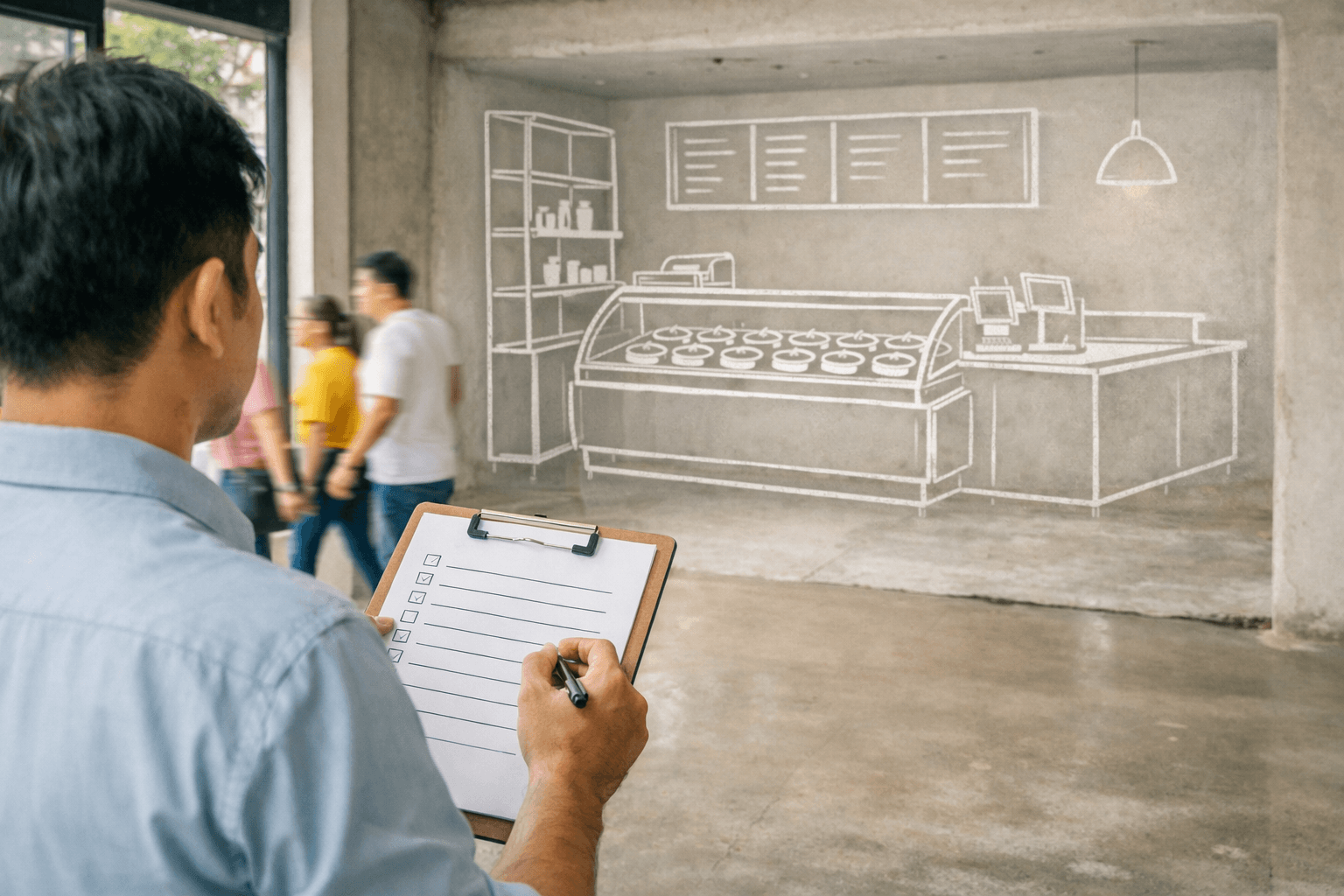
A busy street corner can make an immediate impression at first glance, but that is not a strong enough reason to pay a deposit. When assessing a site for a Gelato kiosk, the question to answer is: are the people passing by the right customer group, present at the right times and able to generate revenue for the proposed business model?
Choosing a site because it feels like “this place looks like it could sell well” can easily put investors in a difficult position: signing the lease first, then looking for products and an operating approach to fill the space. A safer sequence is to identify customers, competitors, the business model and financial limits before assessing the sales location.
The F&B business start-up programme at Concepts Academy also connects tasks including identifying customers and competitors, developing a business model, preparing a financial plan, calculating profit and loss, choosing a site and preparing the contract. The programme is aimed at people researching or preparing to open a shop, and is also suitable for new shop owners with one or two locations who want to rebuild their foundations. Based on these workstreams, Baby Boss has organised six practical steps specifically for those considering a Gelato kiosk.
Step 1: Identify the customers the sales location must serve
Do not start with the question “what is this site suitable for selling?”. Start with the people you want to serve, then check whether the location helps them see, reach and buy Gelato conveniently.
Write a one-page customer profile
- Are the main customers school pupils, university students, working people, families, shoppers or passers-by?
- Do they usually appear in the morning, at midday, in the afternoon, in the evening or at weekends?
- Do they need somewhere to sit or mainly buy to take away?
- Do they arrive on foot, by motorbike, by car or while moving around inside a shopping centre?
- Are products sold as individual portions, for groups or combined with drinks and other food?
Each answer needs to be converted into a requirement for the site. A takeaway kiosk must have a clear access flow and a streamlined service process. A family-focused model needs to consider stopping space, waiting space or a suitable seating area. These are criteria established by the investor and cannot be inferred solely from the appearance of the location.
Count the right people at the right times
Conduct surveys during time slots that coincide with the intended trading hours. During each observation period, it is advisable to separate three figures: the total number of people passing by, the number who fit the customer profile and the number who can reach the kiosk without encountering an obvious obstacle.
A crowd that appears outside operating hours is of little help in forecasting revenue. Likewise, a high volume of passing vehicles may not be valuable if customers find it difficult to stop or do not have time to notice the kiosk.
Step 2: Survey competitors and substitute products
The competitors of a Gelato kiosk are not limited to another Gelato kiosk. At the same time, customers may choose ordinary ice cream, milk tea, cold drinks, desserts or fast food. The survey should therefore cover both direct competitors and substitute options.
Create a competition map that is sufficient for decision-making
| Information to record | Survey questions |
|---|---|
| Product type | What direct and substitute options are currently available to customers? |
| Location | Is the competitor before or after the main flow of movement? |
| Service format | Do customers buy to take away, sit in or use both options? |
| Operating hours | Do the trading hours overlap with those planned for the kiosk? |
| Listed price | What portion size does the observed price apply to? |
| Visibility | Can customers easily see the kiosk, display cabinet and entrance? |
The purpose is not to copy competitors. The survey table should help you identify the gap between customer needs, the proposed products and the actual conditions in the area. If you cannot yet explain why customers should choose your kiosk instead of the options already available, you should not move on to paying a deposit.

Step 3: Finalise the business model before measuring the space
The same floor area will require different layouts for a standalone kiosk, a kiosk integrated into an operating shop and a stall in a shopping centre. Therefore, describing a space as “spacious” or “narrow” only has meaning once the sales format and product mix are clear.
Draw the sales flow on the plan
- Identify the direction from which customers approach and the position from which they read the menu.
- Mark the points for ordering, payment, waiting and collection.
- Arrange the display, storage, preparation, stockholding and cleaning areas.
- Check whether staff movement crosses the queue.
- Separate the area that generates revenue from the area used for operations.
If they plan to sell Baby Boss products, investors can review the Baby Boss Gelato product catalogue before finalising the sales mix. This helps determine which products the kiosk needs to serve, rather than renting the space first and then trying to fit products into the available area.
For those preparing a specific business model, the Gelato kiosk set-up consultancy page is the point of contact for discussing products and the scope of preparation. This is Baby Boss's official channel; site decisions still need to be based on the investor's own survey and financial table.
A site is suitable only when it can accommodate the defined sales flow. Nominal floor area may sound attractive, but the usable area will be reduced if the space is divided up, the service route is difficult to organise or queues block shared walkways.
Step 4: Prepare a profit-and-loss statement and calculate the break-even point
Assessing a site for a Gelato counter cannot be separated from the financial calculation. The training content of Concepts Academy places financial planning, profit-and-loss reporting and the break-even formula within the same preparation process before opening an F&B outlet. This approach turns rent from a figure judged by instinct into a limit that can be tested.
Fill in all variables for each option
- Projected revenue: the projected number of orders multiplied by the average value of each order.
- Variable costs: costs that increase or decrease according to the number of products sold.
- Fixed costs: rent and other costs that must still be paid even when sales volumes change.
- Projected profit: the amount remaining after deducting the identified cost groups from revenue.
- Break-even threshold: the level of revenue just sufficient to cover the costs included in the calculation.
Each site needs its own table, but the same set of assumptions must be used for comparison. Do not increase the projected customer volume while keeping service capacity unchanged, and do not overlook costs that arise only at a particular location.
Test a cautious scenario
The spreadsheet should include one plan-based scenario and one more cautious scenario. If revenue is lower than expected, within what range can the available cash flow cope? If just a small change in order volume or costs causes the result to shift from profit to a shortfall, the rental option needs to be reviewed.
The break-even point does not mean the site is certain to succeed. It shows the minimum sales level required by the current financial assumptions. That figure should be cross-checked against the suitable customer volume observed at the initial stage.
Step 5: Check visibility, accessibility and operational suitability
Once the model and financial limits are clear, return to the site with the counter layout in hand. At this point, you are no longer viewing a house or retail unit; you are testing how to fit the entire business operation into the actual space.

On-site checklist
- Visibility: can people travelling along the main flow see the site before walking past it?
- Accessibility: is the entrance clear, and are there any bottlenecks or obstacles?
- Customer flow: will the expected queue affect shared walkways or adjacent areas?
- Operational space: can areas for receiving goods, storage, preparation, utensil cleaning and stock storage be arranged?
- Handover conditions: which items are already in place, which need to be added and which party is responsible?
- Operating hours: do the permitted operating hours match the times when target customers are present?
Store data published by Baby Boss shows that Gelato can be present in various types of retail locations. The current system has stores in shopping centres such as Baby Boss Aeon Hà Đông, Baby Boss Gigamall Thủ Đức, Baby Boss Vincom Bà Triệu and Baby Boss Vincom Thảo Điền; alongside these are addresses outside shopping centres, such as Baby Boss Dĩ An and Baby Boss Phan Văn Trị.
These addresses should only be used as references for how retail locations are positioned in different types of sites. You can view the published information on the Baby Boss store system, but an existing model should not be used as a substitute for surveying the area under consideration.
Step 6: Score the options and set exclusion conditions
A useful checklist must lead to a decision, rather than ending as a collection of disconnected notes. Assess all options using the same criteria and the same scale that you establish. At the same time, separate priority criteria from mandatory conditions.
Summary table before negotiation
| Criteria group | Decision question | Result |
|---|---|---|
| Customers | Is the customer group and time slot right? | Pass / needs checking / exclude |
| Competitors | Does the counter have a clear reason to exist in the area? | Pass / needs checking / exclude |
| Model | Can the space accommodate the planned sales and service flow? | Pass / needs checking / exclude |
| Finance | Does the cautious scenario fall within acceptable limits? | Pass / needs checking / exclude |
| Retail location | Can customers recognise and conveniently access the counter? | Pass / needs checking / exclude |
| Commitment | Have the handover items, costs and terms of use been clearly set out? | Pass / check / reject |
Before negotiating or paying a deposit, write down the conditions that would make you reject an option: the wrong customer group, an unworkable service flow, an unfeasible revenue threshold based on the chosen assumptions, or important usage conditions that have not yet been clarified.
Rejection conditions must be set before emotions about an attractive location, a favourable rent or the pressure to secure the premises arise. The “pass, check, reject” method does not replace investment decisions; it helps place options on an equal footing for comparison.
Condensed checklist to take with you when viewing a site
- The target customers and the times when they are present have been described.
- Direct competitors and alternatives in the area have been recorded.
- The sales format, product mix and service flow have been finalised.
- A revenue, cost, profit and break-even analysis has been prepared for each individual location.
- Visibility, accessibility, counter layout and handover conditions have been checked.
- The same criteria have been used to score the options, and rejection conditions have been identified before paying a deposit.
A good premises does not necessarily have every advantage. It is a place that serves the right customers, suits the model and does not require the financial plan to rely on an overly fragile scenario.
Is a busy premises automatically good enough?
No. The total number of people passing by is only the initial data point. You must also determine how many belong to the target customer group, when they are present and whether they can conveniently access the counter.
Should you choose the products first or the premises first?
You should define the product mix and service format before finalising the floor area. These two factors determine the display, storage, ordering, payment and collection arrangements, as well as the space allocated to operations.
When should you reject a premises?
You should reject it when the location targets the wrong customer group, cannot accommodate an effective service flow, exceeds your financial limits or still has important usage conditions that have not been clarified. Writing down these conditions before entering negotiations will make the decision less dependent on emotions.
References
Grow with Baby Boss
Discover products and Baby Boss services, or call 1900998880.
Shopee · TikTok · Instagram · Threads · YouTube · LinkedIn · Zalo OA · Pinterest
Comments